Frost basics
What it is
Frost forms when water vapor in the air condenses and freezes on surfaces as temperatures drop to or below 32°F (0°C). It’s primarily a surface cooling process: the official air temperature may remain slightly above 32°F (0°C), while plant tissue and exposed surfaces drop below freezing and form frost.
In northern states and higher elevations — including Minnesota, North Dakota, South Dakota, Montana, Maine, and mountain regions of Colorado or Alaska — frost is a routine seasonal event. Early fall and late spring frosts are common, so growers often plan planting and protection around known freeze windows.
Fast takeaway
If the local forecast shows a clear, calm night with temperatures near 32°F (0°C), expect frost formation and plan protection before sunset.
Pay close attention to low-lying fields and sheltered areas, where surface temperatures can fall several degrees below the official air reading.
 Frost crystals on leaves
Where and why it hits
Microclimate
The "Sink" Effect
Cold air is denser than warm air and naturally drains downhill under calm conditions. This creates temperature inversions in valleys and low-lying fields, where surface temperatures can be several degrees colder than nearby higher ground.
Surface vs. Air Temp
Reported air temperatures do not always reflect plant surface temperatures during radiational frost conditions. Under clear skies, surfaces lose heat quickly through radiational cooling. It’s common for windshields, metal equipment, and leaf surfaces to freeze even when the official air temperature remains slightly above 32°F (0°C).
The Cloud Blanket
Cloud cover reduces overnight heat loss by limiting outgoing longwave radiation. Clear, still nights allow rapid cooling, which is why radiational frost is most likely when skies are cloud-free and winds are light.
Field habit: Walk low spots in the late afternoon. If you notice cooler air pooling early, that area is often the first to frost when winds go calm overnight.
Types of frost
Know your enemy
White frost
White frost (hoar frost)
White frost (hoar frost) typically develops on calm, clear mornings when moist air deposits visible ice crystals on plant surfaces during a light freeze. It can look severe, but damage is often limited unless temperatures drop well below 32°F (0°C) or plants are highly tender.
Black frost
Black frost
Black frost occurs under cold, dry air with little or no visible ice. Plant tissues freeze internally, which can rupture cells. Damage is usually most noticeable after sunrise as foliage darkens and collapses.
Rime ice
Rime ice
Rime ice forms when supercooled fog droplets freeze onto surfaces, usually with wind. In orchards, heavy rime accumulation can add weight to branches and increase the risk of breakage.
Rule of thumb:
White frost warns you, black frost destroys you, and rime ice breaks things.
Protecting your rows
Small scale
Not all crops require equal frost protection, especially during a light freeze warning or frost advisory. Prioritize high-value or frost-sensitive plants first, especially during marginal freeze events.
1
Know Your Vulnerability
- Tender (High Risk): Tomatoes, peppers, squash, beans, and soybeans are highly susceptible to tissue damage at or just below 32°F (0°C).
- Hardy (Lower Risk): Cabbage, kale, onions, and carrots often tolerate light frost and frequently recover without meaningful yield loss.
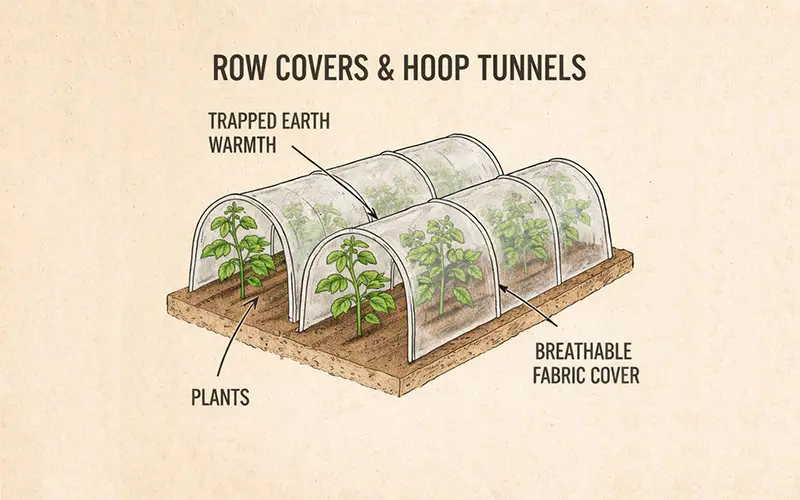
2
The Covering Rule
Install protective covers before sunset on clear, calm evenings. The goal is to trap residual soil heat and reduce overnight radiational heat loss.
- Materials: Old blankets, burlap, or ag-fleece.
- The Trick: Secure the edges all the way to the ground. Any gap lets cold air move underneath and defeats the purpose.
- Avoid Contact: Use stakes or hoops when possible. If a wet cover rests directly on leaves and freezes, it can still burn the tissue.
If you fight frost every year, it’s worth having:
-low tunnels
-hoops with plastic or fabric
-cold frames
These don’t need to be elaborate. Even basic hoops and plastic can buy extra weeks in spring and fall when frost risk is frequent.
3
Water and Mulch
Moist Soil Retains Heat: Dry soil loses heat quickly. If a frost event is expected, irrigating in the afternoon can help soil store more heat and release it gradually overnight.
Mulching: Straw or grass clippings provide insulation for root zones. This approach is especially useful for root crops and perennials during extended cold spells.
Orchards & large fields
Scale solutions
In large orchards and commercial fields where covering is impractical, frost protection shifts from passive insulation to active temperature management.
1
Wind Machines
Wind machines are used in commercial orchards to disrupt temperature inversions during overnight freeze events. On radiational frost nights, warmer air can sit above the canopy; mixing that air downward can lift bud-zone temperatures by roughly 2–5°F (about 1–3°C) and reduce injury risk.
2
Smoke Blankets & Orchard Heaters
Orchard heaters (often called "smudge pots") provide localized heat and produce smoke that can reduce radiational cooling. Effectiveness depends heavily on wind, spacing, and fuel type.
3
The Sprinkler Method
Overhead irrigation during freezing conditions can protect tissues through latent heat release as water turns to ice. Continuous application is critical; stopping water too early can increase damage as ice cools further.
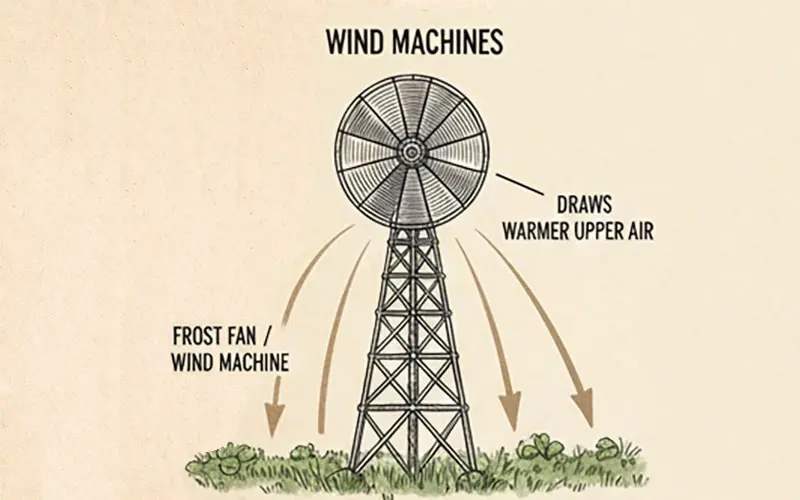 Wind machine mixing warmer upper air to reduce radiational frost damage.
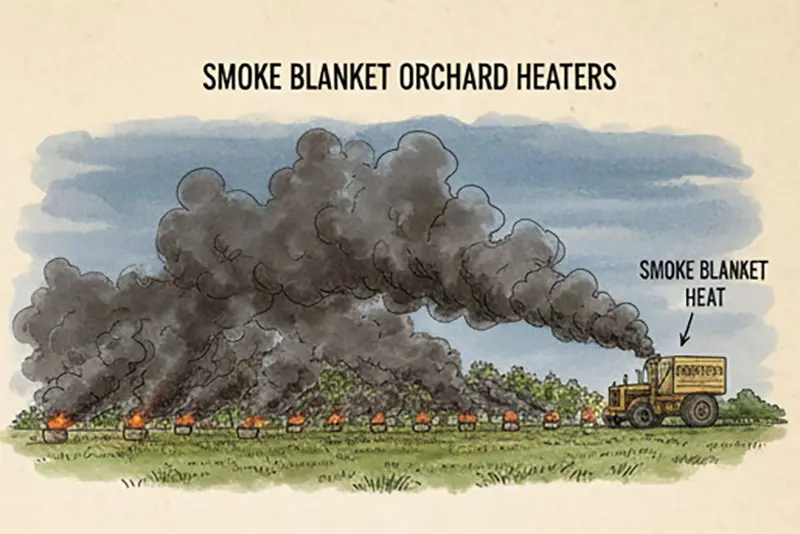 Orchard heaters and smoke reducing overnight radiational heat loss.
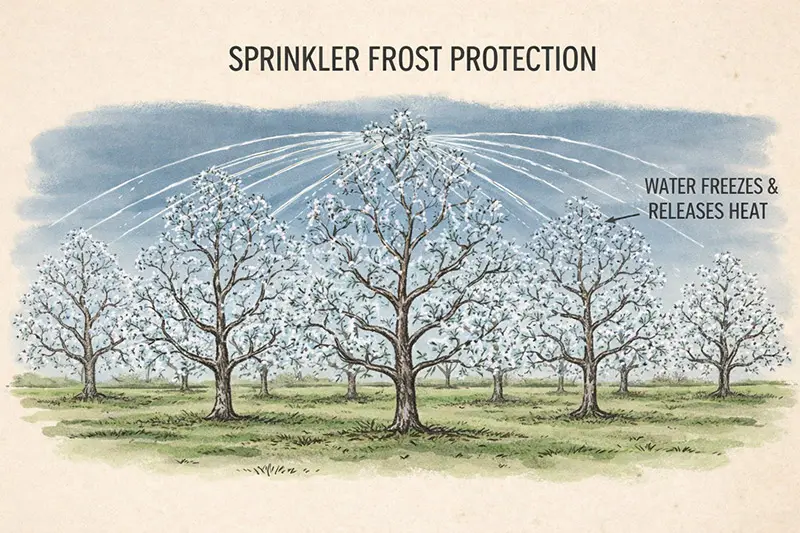 Overhead irrigation protecting buds through latent heat release during freezing.
Timing: when it hits
Critical window
Frost risk typically peaks during the coldest part of the night, most often between about 03:00 and shortly after sunrise. Surface temperatures commonly reach their minimum just before dawn after several hours of steady radiational cooling.
If you are using heaters or wind machines, start them before tissues approach critical freezing temperatures. Once freezing injury begins, warming after the fact is far less effective than prevention.
Simple operational rule
Prep and protect in the evening; don’t “react” after the damage starts.
Farmer’s "Rule of Thumb" Checklist
Clear Night + No Wind + Damp Air Get the covers ready.
32°F to 39°F (0°C to 4°C, clear sky forecast) High risk of radiational ("rural") frost. Check low spots and sheltered areas.
Below 32°F (0°C) Frost is likely overnight. Protect tender plants, early buds, and young fruit immediately.
Cloudy and Windy Lower risk; mixing and cloud cover reduce rapid overnight cooling.